The fondouks of Fez
The fondouks of Fez
The merchant warehouses of a caravan economy, and what survives when the economy that built them ends.
A fondouk is a building with a job that no longer exists.
The job was: receive a caravan, stable its animals, store its goods, house its merchants for as long as the trade required, and provide a fortified place where commercial transactions could happen without theft. Every Moroccan medina of any commercial importance had several. Fez had over two hundred at its peak in the seventeenth century, distributed throughout the medina according to which trade they served — fondouks for the leatherworkers, fondouks for the silk merchants, fondouks for the gold dealers, fondouks for the slave traders coming up from Sub-Saharan Africa, fondouks for the Andalusian Jewish dealers in cloth.
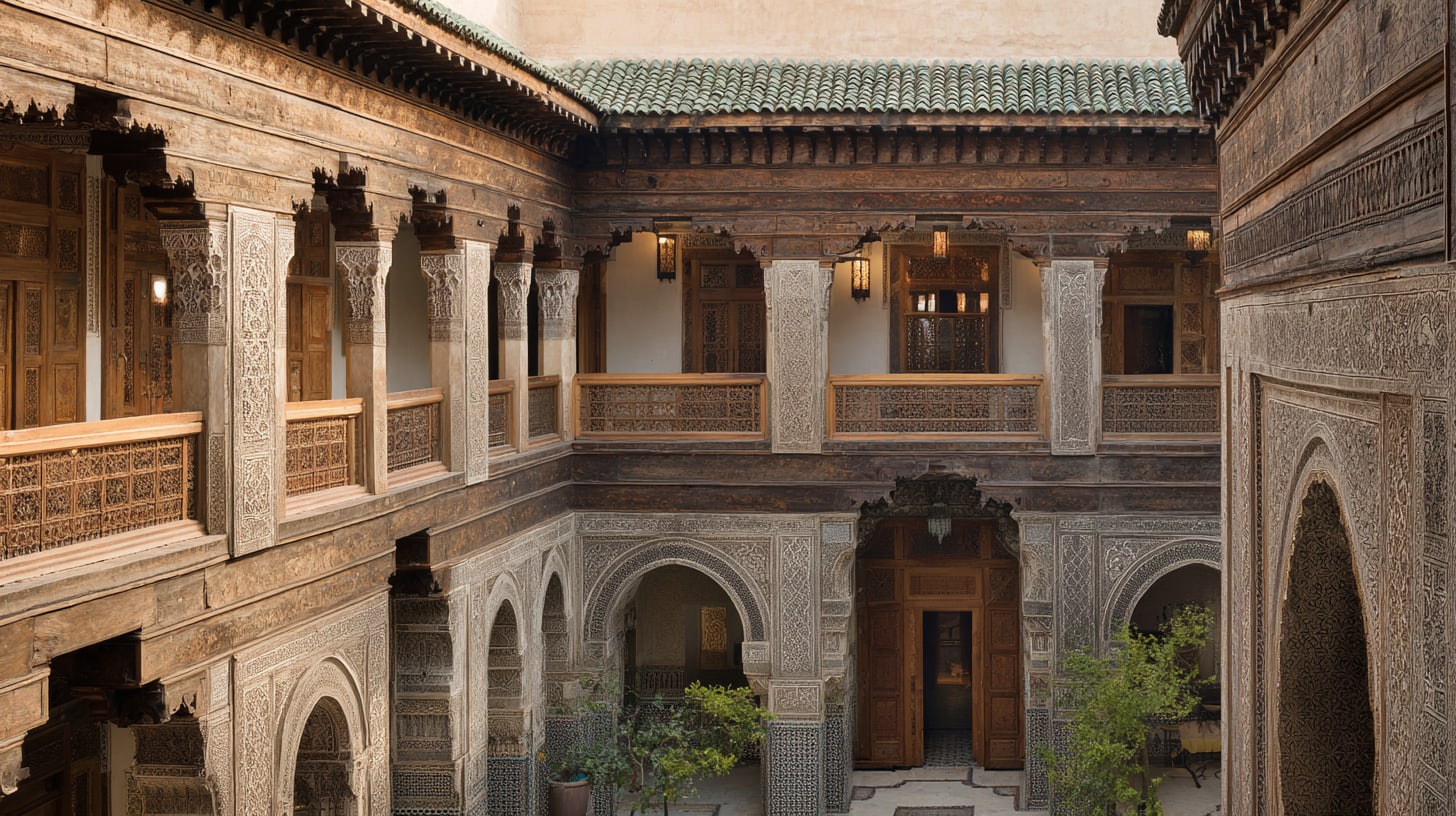
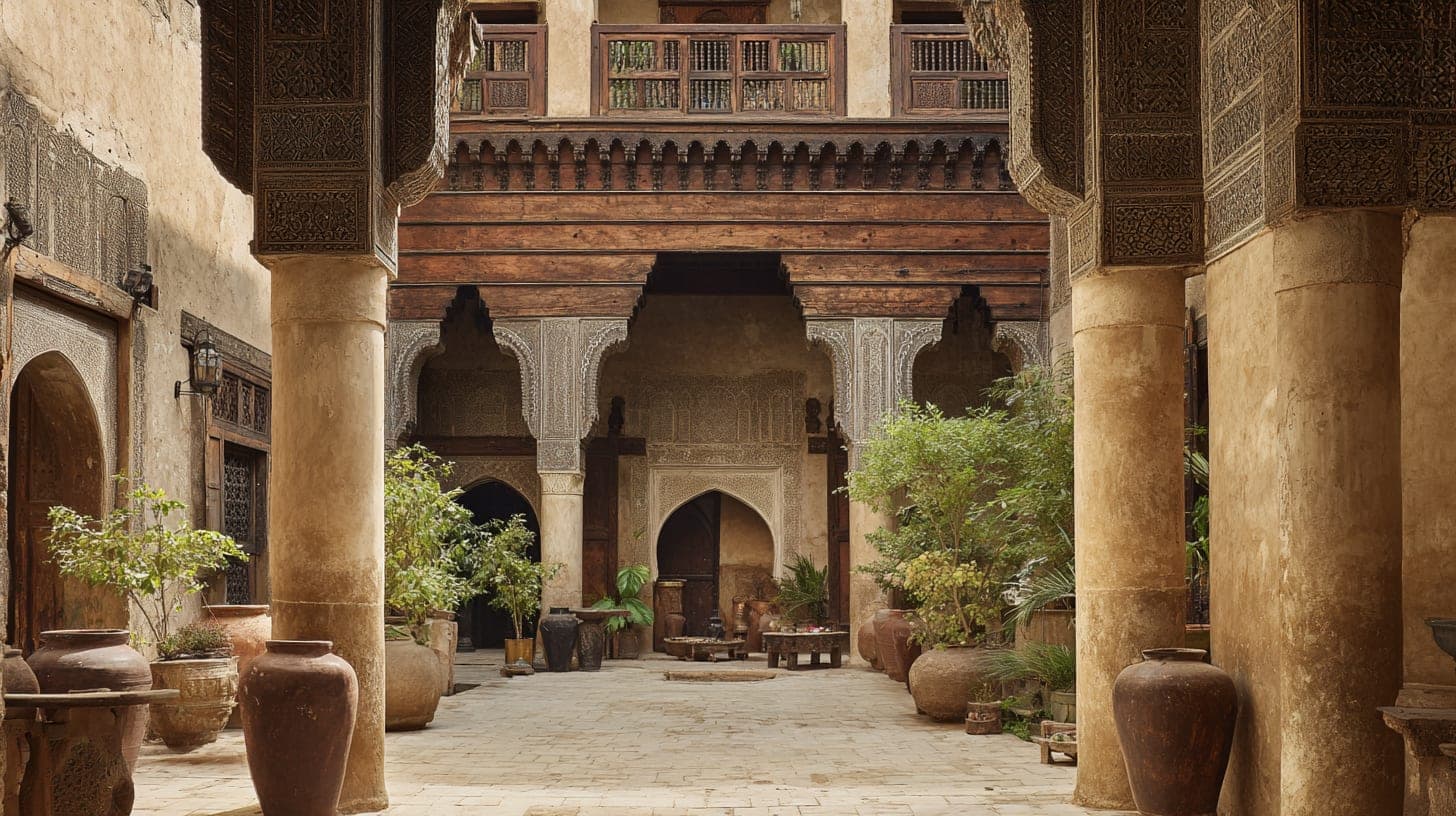
The architecture is recognisable across all of them. A square or rectangular plan, two or three storeys high, with a central courtyard. The ground floor opens onto the courtyard with deep arcades, used for stabling animals — horses, mules, donkeys, camels — and storing the merchandise the animals brought in. The upper floors, reached by external staircases, contain rooms ranged around the courtyard: small chambers for individual merchants, larger ones for the guildmasters, sometimes a masjid for prayer, sometimes a small bath. The whole structure could be locked at night by closing the heavy main door, and the courtyard then functioned as a self-contained, defensible little village.
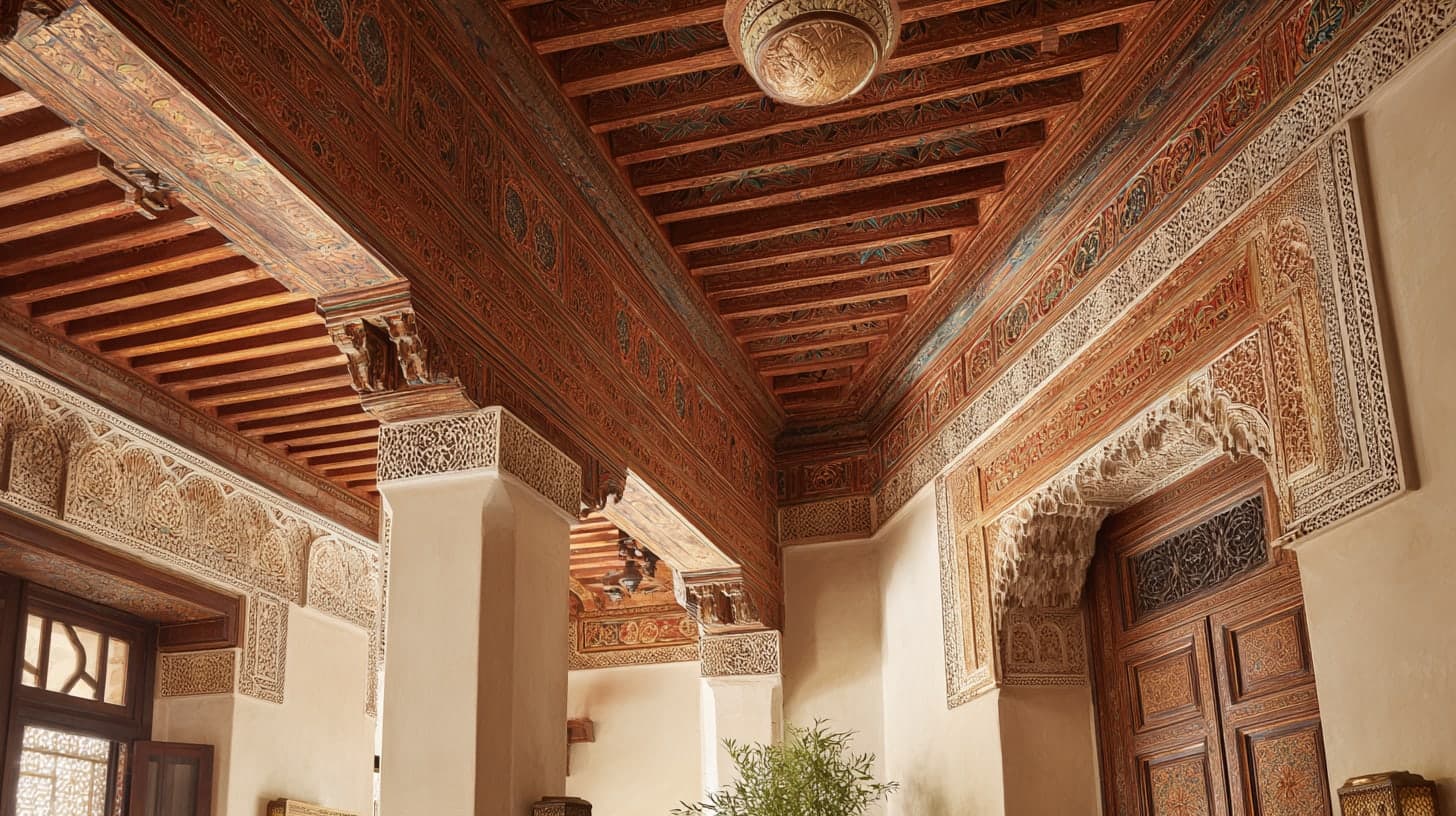
The Fez fondouks were built between roughly 1100 and 1700, with the majority dating to the Marinid and Saadian periods (13th-16th centuries). They were not modest buildings. The most important — the Fondouk Nejjarine near the carpenters' quarter, the Fondouk Kaat Smen near the spice markets, the Fondouk Tazi off the Talâa Kebira — were among the most architecturally elaborate commercial structures in North Africa, with carved cedar arcades, plaster fretwork, painted ceilings, and zellige floors that rivalled the principal mosques of the city.
What ended this architecture was the trade. The trans-Saharan caravan economy that supported the Moroccan fondouk system was already in decline by the seventeenth century, displaced by the Atlantic shipping routes that the Portuguese and then the Dutch and English had developed for moving West African goods directly to Europe. By the time the French arrived in the early twentieth century, most of the original fondouk traffic had been replaced by domestic Moroccan commerce running through smaller, less specialised commercial structures. The grand fondouks survived as physical buildings, but their original function — housing merchants and animals from a multi-week caravan journey — had become irrelevant.
The buildings adapted, sometimes badly. Some fondouks were converted to artisan workshops, with the ground-floor stables becoming carpenters' or coppersmiths' working spaces. Some became low-rent housing for the families of artisans who could not afford their own dars. Some became storage for the new trades of the modern medina — refrigerators, bicycle parts, plastic sandals, cheap textiles. A few were preserved as museum-quality examples of the architecture: the Nejjarine, restored in the 1990s, is now the Wood Arts Museum of Fez and is one of the finest experiences in the city. But most were not preserved. They were reused, partly demolished, partially rebuilt, occasionally collapsed, occasionally torched in the small fires that sweep periodically through dense urban quarters.
The result, in 2026, is that of the original two hundred fondouks of Fez, perhaps thirty-five remain in recognisable form. Of those thirty-five, perhaps eight are in genuinely good condition. The other twenty-seven are in various states of partial preservation, partial reuse, partial collapse. The trajectory is downward.
Walk into one of the lesser fondouks of the Talâa Sghira quarter, at three in the afternoon. The main door is open because the building is occupied. The central courtyard, perhaps fifteen metres on a side, is partly covered by tarpaulins and corrugated metal roofs added at various points over the last century. The original arcaded ground floor is mostly walled-up to create separate workshop spaces, with new doors cut into the walls and old arches partially visible behind the new construction. The first-floor staircase is intact but the original carved railings are missing, replaced by metal pipe. The upper rooms are occupied, mostly as storage, some as living quarters for families who have been there for generations.
Look up. The original carved cedar ceiling of the entrance hall is still in place, partly visible through accretions of paint and electrical wiring. The original tile work along one wall of the courtyard is still there, though chipped and discoloured. The geometry of the building — the proportions of the courtyard, the rhythm of the arcades, the relationship of the staircases to the upper floors — is intact even though every detail has been compromised. A trained eye can read what the building was. An untrained eye sees only the mess.
This is what most of the surviving fondouks of Fez look like in 2026. The eight that are in genuinely good condition — the Nejjarine, the Kaat Smen, the Tazi, three or four others — have been restored either by the state, by international heritage organisations, or by private foreign owners who bought them and committed serious capital to bringing them back. The other twenty-seven survive in their compromised state, with their original fabric mostly intact behind the accretions but with no clear path to restoration.
Why this matters for a foreign buyer. Fondouks are occasionally available for purchase. They are not on the standard agency websites. They circulate through specialist channels — heritage-focused real estate intermediaries, the architects who specialise in restoration, the small foreign owners' network in Fez who hear about properties before they are formally listed. Prices vary enormously. A small partially-collapsed fondouk in a peripheral quarter can be acquired for 1.5-2.5 million dirhams. A larger fondouk in a good quarter, with the original fabric mostly intact under the accretions, can range from 5 to 12 million dirhams depending on condition and quarter.
These are not ordinary residential transactions. A fondouk is too large and too specifically configured to function as a single-family house; restoration almost always implies conversion to a use that justifies the scale — a small luxury guesthouse, an artist's residence with workshops, a private cultural centre, a small museum, occasionally a private home for a family that simply wants the scale and is comfortable with the maintenance commitment. The conversion has to respect the original courtyard plan and the original arcade structure, because these are the architectural heart of the building. A fondouk converted into apartments by walling off the courtyard becomes architecturally meaningless within a few years and loses both its heritage value and its commercial appeal.
The restoration challenges are specific. Fondouks have structural issues that residential buildings do not. The ground-floor arcades were designed to support the weight of stored merchandise, which means the ground floor is structurally robust but the upper floors, designed only for human occupation, are often less so. Modern uses that put heavy loads on upper floors — heavy plumbing, high-density occupancy, mechanical systems — can stress the building in ways the original construction did not anticipate. Restoring a fondouk well requires structural assessment by an engineer familiar with traditional Moroccan construction, not just an architect. The pool of such engineers is small.
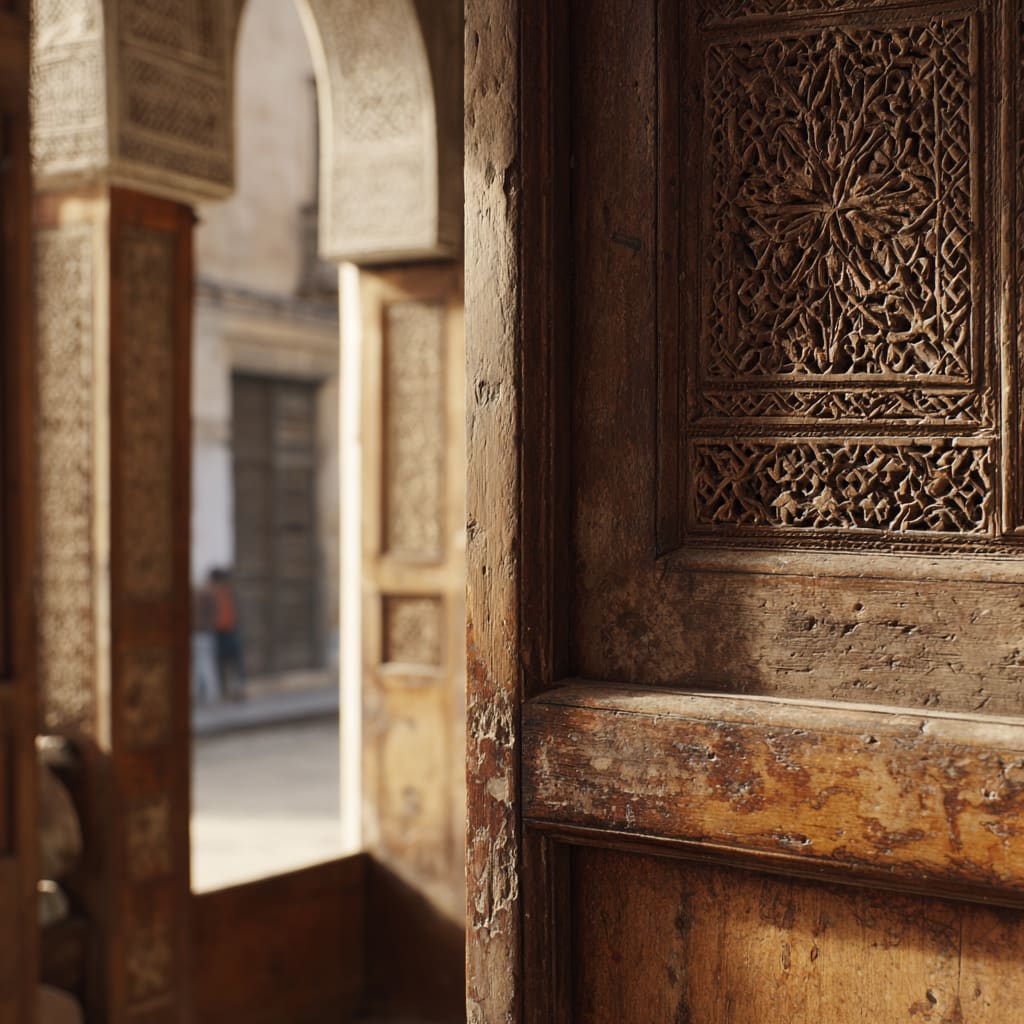
The original carved cedar in fondouks is also a particular challenge. The arcades typically use very long cedar spans — six to nine metres in some cases — to bridge the courtyard openings. Replacing damaged cedar elements at this scale is difficult; the new cedar has to come from yards that handle salvaged material from other buildings, since new cedar of equivalent dimensions is no longer commercially available. The carving has to be done by maalems who can work in the same idiom as the original, which means working from photographs and direct observation rather than standardised patterns. The cost is significant.
The painted ceilings, where they survive, are the most demanding restoration element. Most fondouk painted ceilings have suffered from a combination of water damage from upper-floor leaks, smoke damage from cooking and heating, and direct mechanical damage from added wiring or fixtures. Cleaning and stabilisation of an original ceiling can take a specialist team six to eighteen months for a single principal room. Full restoration, including replacement of missing panels in the original idiom, takes longer. The work cannot be rushed.
For Fez specifically, the fondouk question is at a turning point. The buildings that have been restored well in the last twenty years have demonstrated that the architecture can be brought back, that the resulting structures are extraordinary, and that international demand for the experience of staying or working in a properly restored fondouk is strong. The buildings that have not been restored are continuing to lose fabric every year. Of the twenty-seven compromised fondouks, perhaps a quarter to a third will be lost in the next twenty years if no intervention occurs. The remainder are candidates for buyers who know what they are looking at.
Fez does not have the foreign-buyer concentration that Marrakech does. The pool of international buyers in Fez is smaller, more committed, more architecturally serious, and operates through different networks. A foreign buyer who goes to Fez looking for a fondouk is signalling that they are not a casual tourist who liked the city and decided to buy something. They are signalling commitment to a particular kind of restoration project that will absorb capital, attention, and years of work. The few people who fit this profile — and they exist — are among the most interesting foreign owners in Morocco.
The fondouks were built for a trade economy that no longer exists. The buildings have outlasted their original function by three or four centuries. Whether they outlast the present century depends on who is willing to take them on. The work is not for everyone. The buildings are not for everyone. But for the small set of people who recognise what these structures are and who can commit to bringing them back properly, the fondouks of Fez are some of the most extraordinary architectural opportunities still available anywhere in the Mediterranean basin.
The trade is gone. The buildings remain, for now. What happens next is not certain.