The kasbahs of the south
The kasbahs of the south
What survives, what doesn't, and what a foreigner sees standing in front of Kasbah des Caïds.
The road from Marrakech to Telouet climbs for two hours through the Tizi n'Tichka pass.
The Atlas drops away on either side. The road narrows. The villages cling to the slopes in tiers of pisé and stone, their flat roofs piled with drying corn, their walls the colour of the earth they sit on. Above three thousand metres the air is thinner and colder; in winter the pass closes for snow several times a year, in summer the sun is hard and dry. The pass itself crests at 2,260 metres and then descends into a different country: the southern slope of the Atlas, where the climate shifts, the vegetation thins, and the architecture becomes something older.
This is the road the caravans took for a thousand years. The route from Marrakech to Sijilmasa, the southern caravan terminus on the edge of the Sahara, ran through the Tichka and the Drâa, carrying gold from Mali and Senegal northward, salt from Taghaza going both ways, ivory and slaves and indigo and dates. The kasbahs along this road were not decorative. They were defensive infrastructure for a trade economy that ran on the assumption that any caravan was a target, and that the local lords charged tolls or levied taxes or simply seized goods depending on how strong they were that decade.
The kasbahs that remain are the surviving fragment of this system.
Telouet is the most famous. It was the seat of the Glaoui — the Berber clan that, in the late nineteenth and early twentieth centuries, levied tolls on the Tichka pass and accumulated enough wealth and political power to become, briefly, one of the most influential families in Morocco. Thami el-Glaoui, pacha of Marrakech from 1912 to 1956, was the most famous Glaoui. He hosted Churchill, Roosevelt, and most of the European aristocracy of the inter-war years; he was a kingmaker in Moroccan politics; he was eventually disgraced after independence and his properties were seized. The Telouet kasbah, his ancestral home, was abandoned and has been falling for seventy years.
What is left at Telouet is one of the most affecting ruins in Morocco. The outer walls and most of the structural floors have collapsed. The upper rooms are mostly open to the sky. But certain rooms — the salon des invités, the salon des ambassadeurs, a few of the smaller chambers around the central court — retained their painted ceilings, their zellige floors, their carved cedar doors, their gilded plasterwork. These rooms, accessible by a narrow staircase the local guardian still opens for visitors, are some of the most extraordinary surviving examples of late-nineteenth-century Moroccan craft anywhere in the country. Painted ceilings of unbelievable intricacy hang above floors of broken zellige, with daylight pouring through holes in the walls of adjacent rooms. The contrast between the still-intact craft of the principal rooms and the disintegration around them is something photographs do not capture. You have to walk through it.
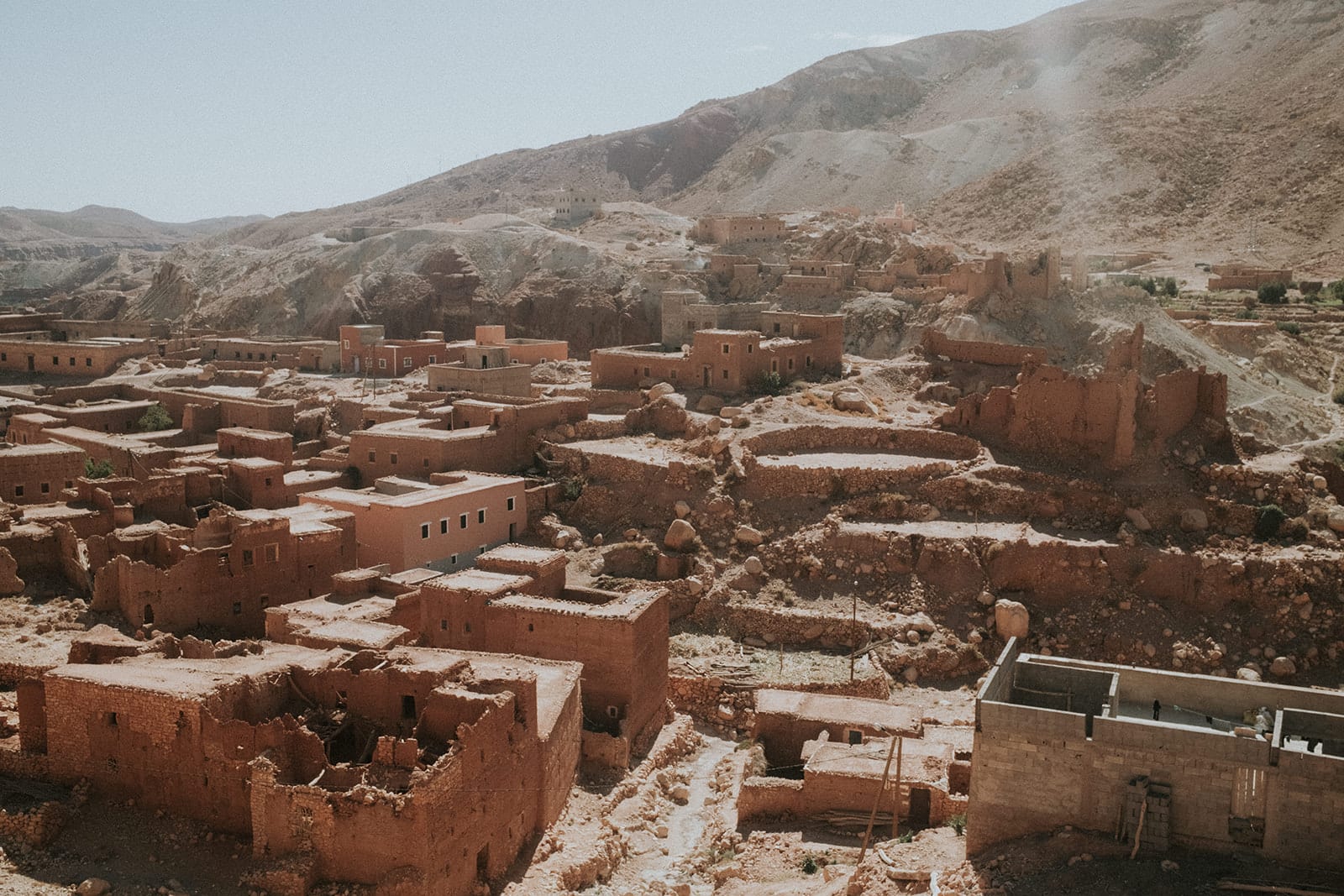
Aït Ben Haddou is the most famous in another way. The kasbah complex on the road between Ouarzazate and the Tichka pass has appeared in dozens of films — Lawrence of Arabia, The Mummy, Gladiator, Game of Thrones — and is now a UNESCO World Heritage site. The combination of UNESCO designation and film production has produced a strange kind of preservation: the buildings facing the river, the ones visible in the films, are kept up; the buildings behind them, away from the cameras, are in slow collapse. The complex is not a single kasbah but a ksar, a fortified village, with a hierarchy of internal kasbahs belonging to the most important families. About half the original 1,500-1,700 inhabitants moved across the river decades ago to a modern village; the kasbahs they left behind are mostly lived in seasonally now, by descendants who return for festivals and funerals.
Skoura is a different kind of place. The oasis of Skoura, fifty kilometres east of Ouarzazate on the road to the Drâa, contains perhaps twenty significant kasbahs distributed through the date palmery. The most famous is the Kasbah Amerhidil, which appears on the back of the fifty-dirham banknote. The Amerhidil family has been in Skoura for several centuries; the kasbah is in private ownership; the upper floors are partially restored; the lower floors house a small museum and a working family home. Other kasbahs in Skoura are in various states of preservation — some restored as small guesthouses, some still inhabited by the original families, some abandoned and falling.
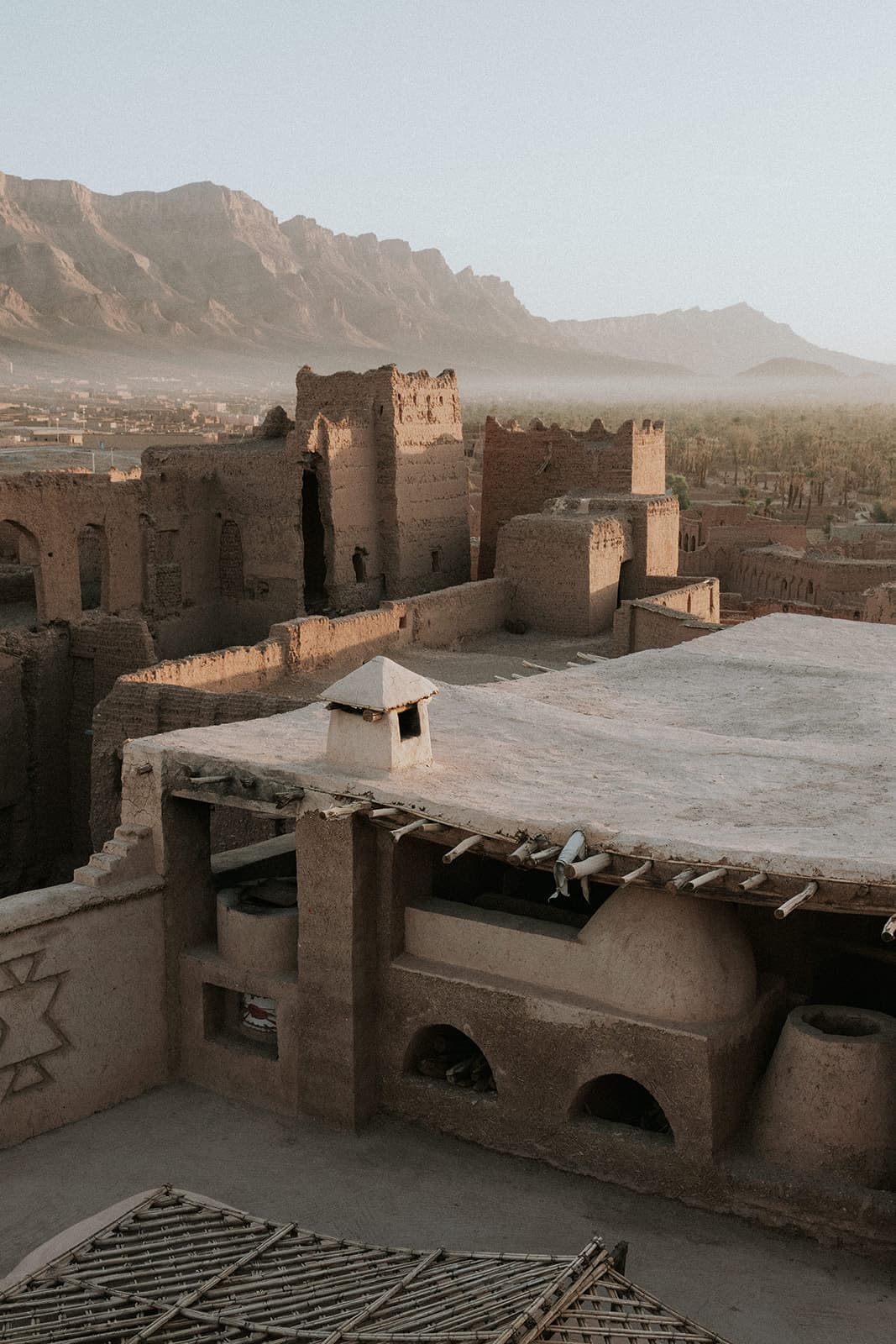
The Drâa Valley between Agdz and Zagora contains perhaps thirty more kasbahs, mostly in advanced states of decay, mostly in valleys where the population has thinned dramatically since the 1970s. The combination of climate stress on the date palmery, depopulation, and lack of restoration craft has been hard on these structures. The valley is one of the most extraordinary landscapes in Morocco — hundreds of kilometres of date palms along a slim ribbon of river, with the kasbahs visible at intervals as warm-coloured rectangles rising out of the green — but it is also one of the places where the architectural loss is most visible year by year.
Kasbah des Caïds.
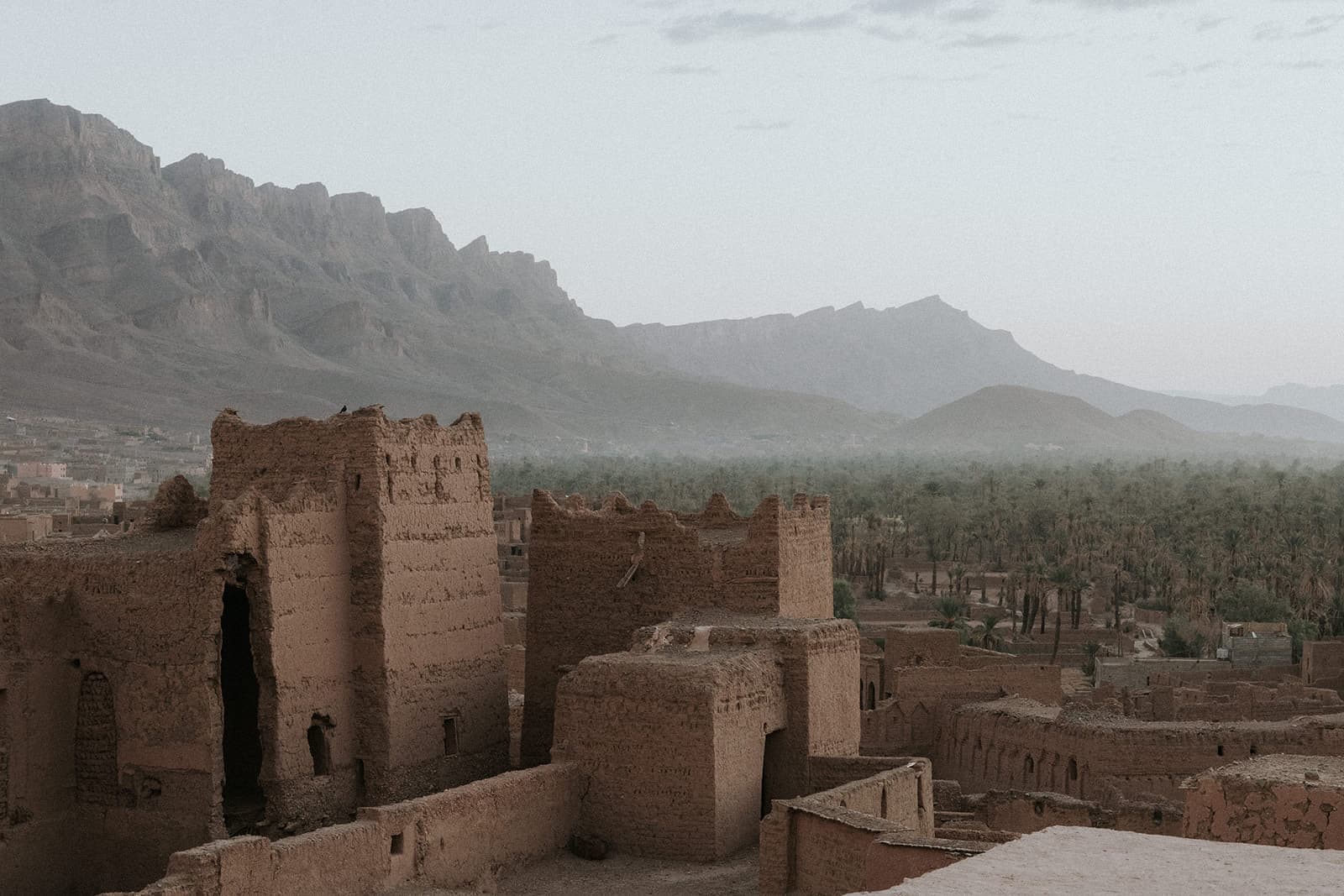
The kasbah at Tamnougalt, on the Drâa about fifteen kilometres south of Agdz, is one of the larger surviving complexes. The local family that built it was the caïd lineage of the area through the seventeenth and eighteenth centuries; the building was the administrative seat of the region for several hundred years before its functions migrated to Ouarzazate and Agdz. The structure is mostly intact — outer walls, inner courts, painted ceilings in the principal rooms, original wooden lintels and shutters, original irrigation channels in the palmeraie below.
What you see when you arrive is a wall of pisé five storeys high, the colour of the river silt and the surrounding cliffs, articulated by narrow defensive windows and finished at the top with the zigzag merlons characteristic of southern Moroccan fortification. The wall faces away from the road, toward the palmery and the river; you have to circle the building to find the entry, which is a small studded wooden door set into a deep stone arch. Inside, the proportions shift. The internal courts are quiet, shaded, cool even in midsummer. The walls press close. The light comes from above and from the small window slits, indirect and soft.
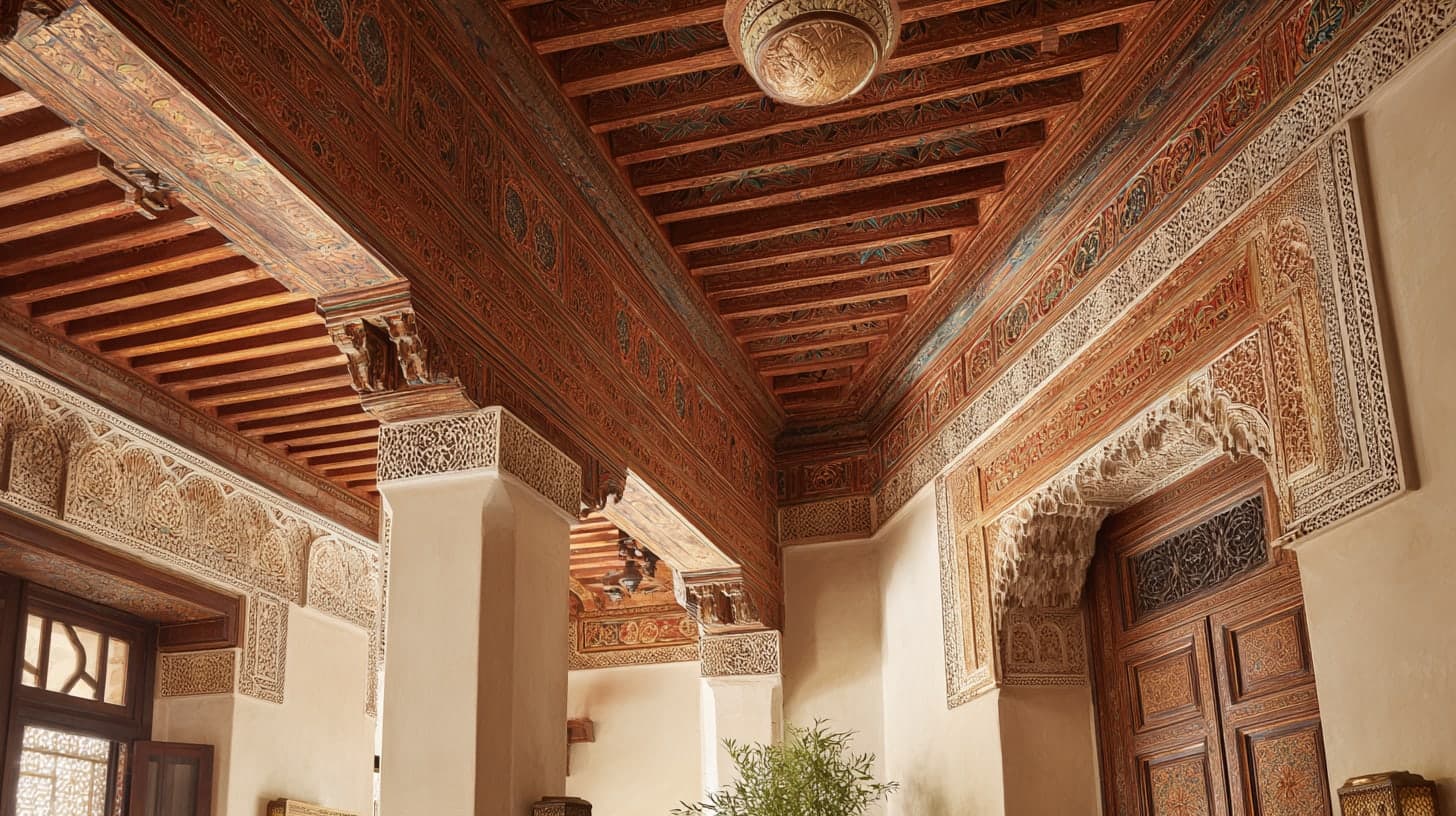
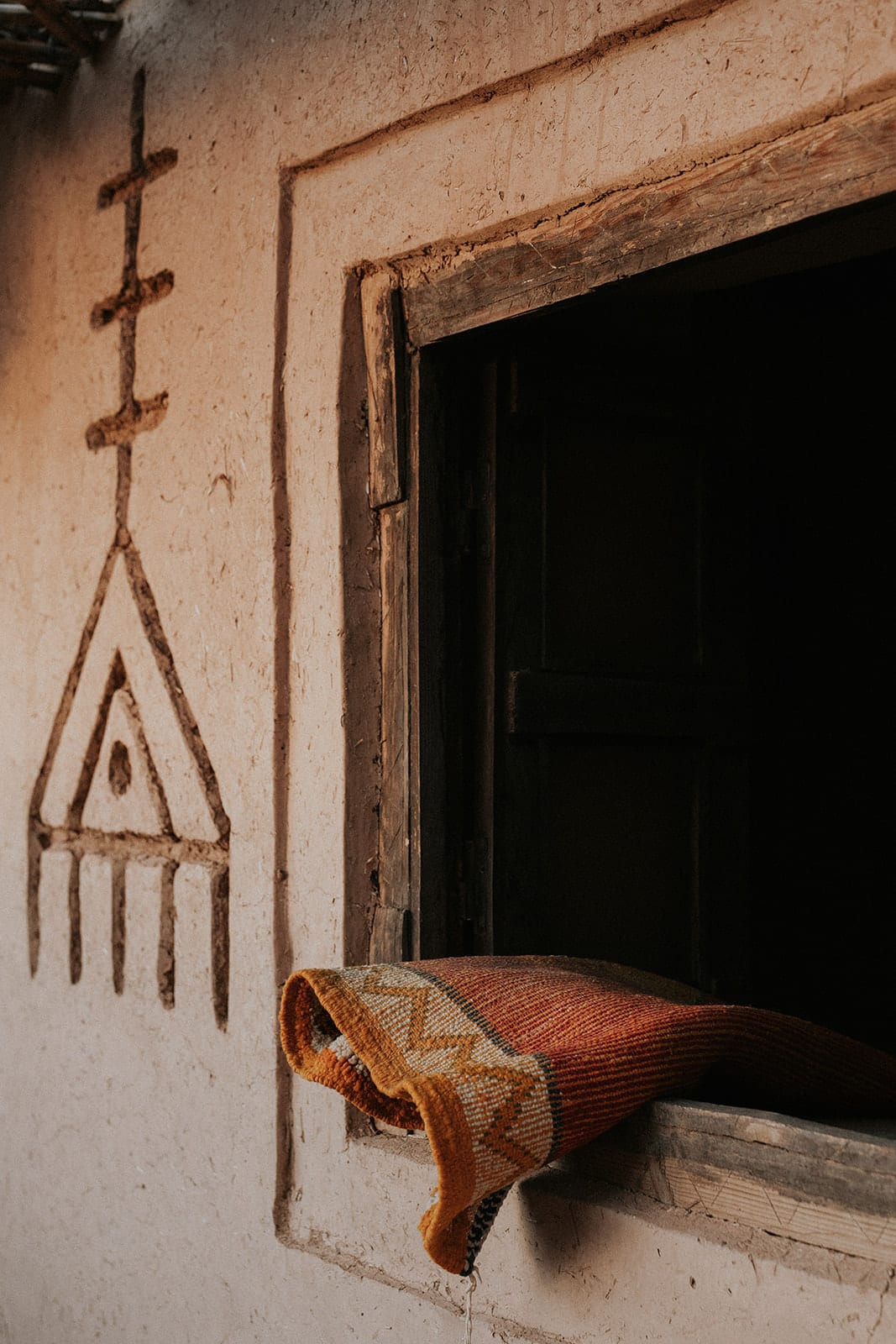
The principal salon of Kasbah des Caïds, on the upper floor, has its painted ceiling intact. The geometry is different from a Marrakech ceiling — denser, more concentrated, with smaller motifs and tighter colour contrasts. The southern style favoured deeper reds and greens than the Marrakech style, with more direct geometric repetition and less of the floral influence that came up from Andalusia through Fez. The ceiling work in this room is probably late eighteenth century, applied during a renovation by one of the caïd's descendants. The floor is original bejmat, the small fired-clay tiles laid in chevron patterns; the walls are tadelakt over pisé, in a deep oxblood red that has been refreshed at least twice in the last century.
What is striking, standing in this room, is not the craft alone but the silence. The kasbah is twenty kilometres from the nearest town. The palmery muffles the river. There are no cars, no aircraft, no electrical hum. The room receives the same indirect light it received in 1810. You can hear, faintly, the irrigation water moving through the seguia below, and the wind in the date palms. Nothing else.
This is what is at stake in the southern kasbahs. Not just the buildings, but the silence the buildings sit inside, the relationship to the land, the particular kind of light that comes through specific window slits at specific times of day. Tamnougalt has survived because the family has held it, because some of the descendants live nearby, because the structure has had basic maintenance during the period when most other kasbahs were left alone. But it is not safe. Every winter brings rainfall events the structure was not designed for. Every year the maintenance is more expensive and harder to find craftspeople for. The family is conscious of this. They are not selling.
Many other families are. The southern Moroccan property market in 2026 contains a number of kasbahs available for purchase, ranging from small structures in advanced disrepair to substantial complexes in reasonable condition. Prices vary enormously — from 500,000 dirhams for a partially-collapsed building requiring complete restoration, to 8-10 million dirhams for a restored kasbah operating as a small luxury guesthouse. The buyer who is looking seriously needs to understand what they are buying.
What they are buying is a piece of architectural infrastructure that took several generations to construct, that has lasted two or three centuries, and that requires ongoing care from craftspeople who are increasingly scarce. The cost of acquisition is often the smallest cost. The cost of restoration is significant. The cost of maintaining a properly restored kasbah, year on year, is the largest cost — a working maalem on retainer, ongoing repointing of pisé, periodic restoration of painted ceilings, replacement of original cedar elements that finally fail after centuries, irrigation maintenance for the surrounding palmery.
The buyers who do this well treat it as a multi-decade commitment. Some of them succeed extraordinarily — restoring kasbahs that operate as small hotels, that host architectural conferences, that become part of the cultural infrastructure of the south. Others fail, often quickly, and the kasbahs they bought come back to the market in worse condition than when they were acquired.
For the south as a whole, the question is what proportion of the surviving kasbahs will be restored versus lost over the next thirty years. The optimistic projection has perhaps half restored, with the other half stabilised as protected ruins. The pessimistic projection has perhaps a quarter restored and three quarters lost. The actual outcome will depend on the buyer pool, the climate, the restoration craft availability, and the willingness of the Moroccan state to support heritage in a region that is, politically and economically, a long way from Rabat.
For the foreign buyer who falls in love with the southern kasbahs — and many do, after a single visit — the practical question is whether they are the right kind of person to take on what owning one actually means. The right kind is patient, well-financed, committed to the place over decades, willing to defer to local craftsmen, comfortable with a maintenance schedule that does not end. The wrong kind treats it as a project. The kasbahs do not survive being treated as projects.
Standing in the principal salon at Tamnougalt, looking at the painted ceiling that was finished by a maalem who has been dead two hundred years, listening to the water moving in the seguia below, you understand what the south is asking of anyone who wants to enter it. It is asking for stewardship, not ownership. The buyers who hear this question and say yes are the ones who keep the kasbahs alive. The buyers who do not hear it should buy a riad in Marrakech. The two are not the same kind of property, and they are not for the same kind of buyer.
The road from Marrakech to Telouet goes on past Telouet to Aït Ben Haddou, then past Ouarzazate to Skoura, then south to Agdz and Tamnougalt and Zagora and the Sahara. The kasbahs are spaced along it like beads on a string. Some of the beads have already fallen off. Most of the rest are loose. Whether the string holds depends on who is willing to thread it tighter, year by year, for as long as it takes.